Buddy’s short film, from Said Daily

Buddy, the small character with a quotation mark for hair, sits at a wooden table under a tree in a garden while a blue butterfly drifts past. He picks up his phone and its light fills his face as he smiles. Butterflies gather, and the film opens out onto the whole garden, white flowers among the hydrangeas. The film has sound.
jh-014 Reflection One of 32,259
“Your thoughts should visit your mind, not purchase property there.”
Three thoughts each morning, and room to sit with them. Behind them, 32,259 in the library — every one carrying an essay of its own.
 Free
For iPhone, iPad, Mac and Apple Watch.
The morning
Three thoughts, one at a time.
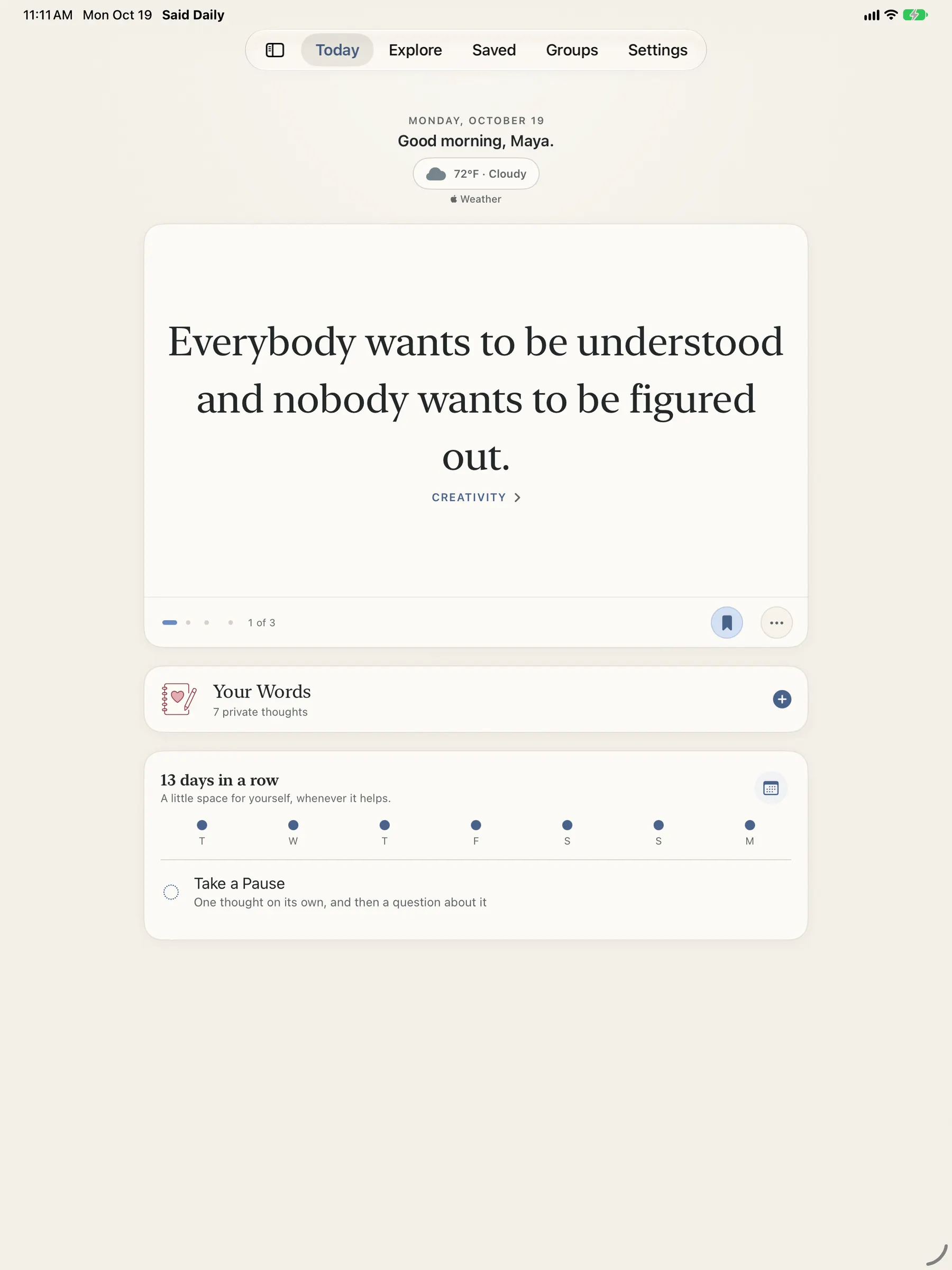
Said Daily opens on the first of the day’s three. Under it are your own words, kept private, and a count of the days you have come back.
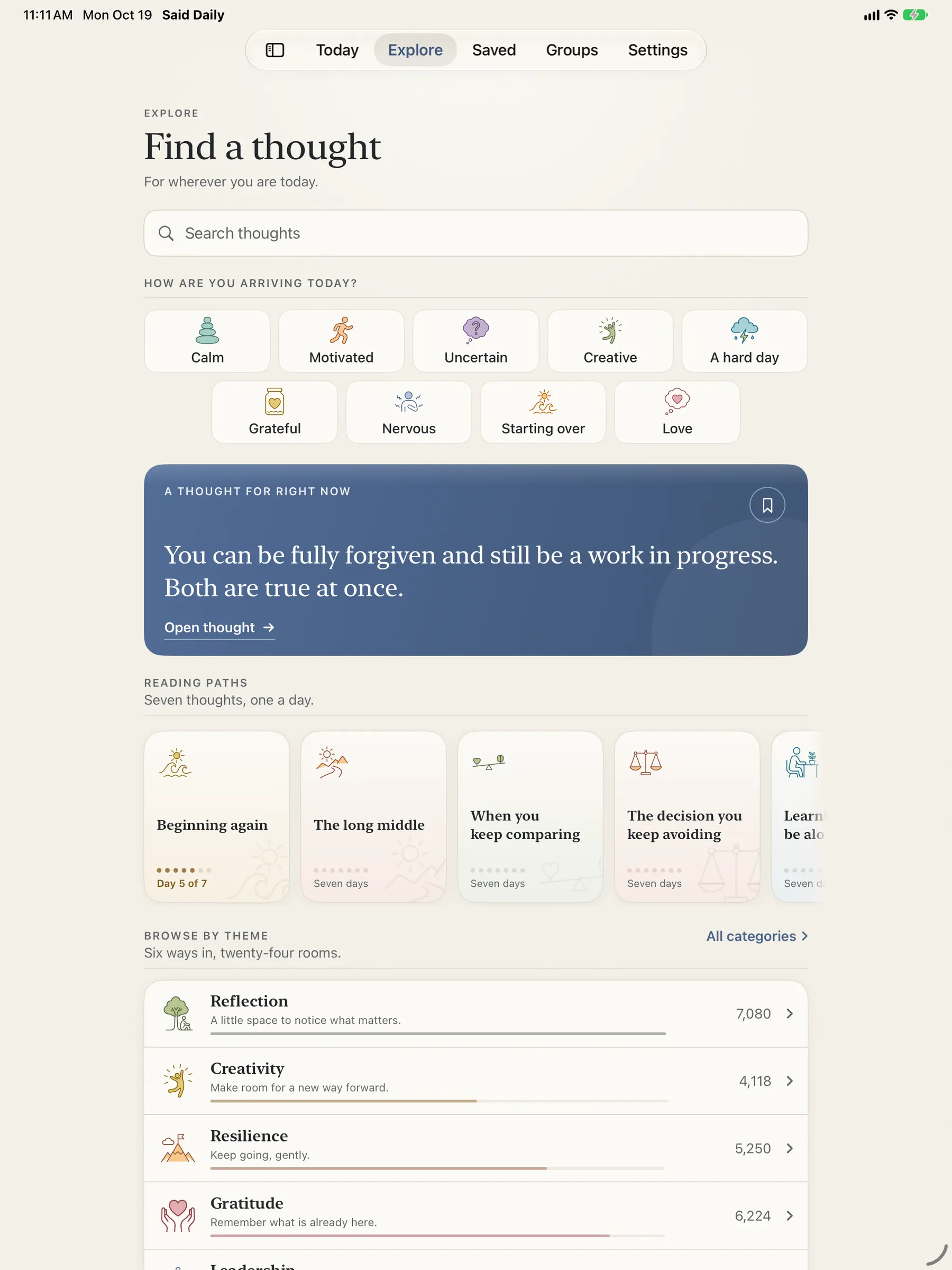
Explore
Find a thought for how you are arriving.
Explore asks how you are arriving today and offers Calm, Motivated, Uncertain, Creative, A hard day, Grateful, Nervous, Starting over and Love. Under them are a thought for right now, reading paths that give you one thought a day, and the themes to browse.
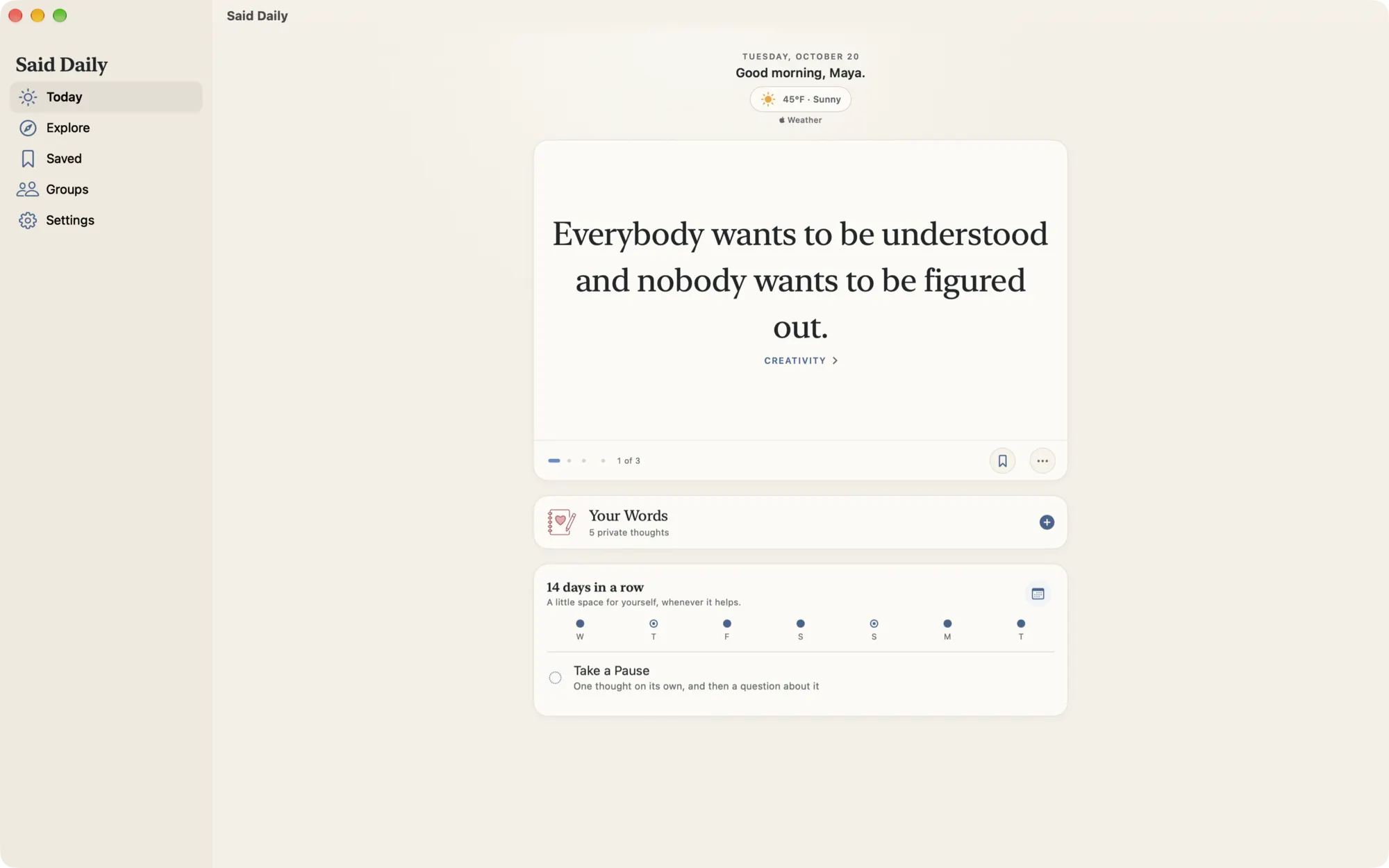
On the Mac Today in its own window, with Explore, Saved, Groups and Settings in the sidebar.
Why it exists
A library of quotations is easy to assemble.
Quotations are short. Gathering them is the part anyone can do. The work is what comes after: saying, in plain words, what one particular sentence means — without saying the sentence back — and then doing it again for the next one, and the next, 32,259 times.
29,229 of the thoughts here were written for the app. 3,030 more are credited to 152 named people. It makes no difference which: every one of them carries its own explanation underneath, and its own question at the end of it.
What it means
Not one is left to speak for itself.
Every one of the 32,259 carries an essay of its own — about a hundred words on what the thought means and why it is worth your time. Then a question, if you want to answer it.
What follows is one of them, complete and unedited: the thought, the words the app puts under it, and the question it ends on.
“You forgot the kind thing you did in seventh grade. The person you did it for didn’t.”
Kindness gets remembered unevenly. What felt like nothing to you, sitting next to somebody at lunch or telling a kid their drawing was good, got filed by them as evidence that they were not invisible, and it has been in there ever since. You will never know which of your small acts landed that way. That is the actual argument for making a lot of them.
This week, do the small obvious thing you usually talk yourself out of because it seems too minor. Say the compliment, invite the extra person, answer the awkward message. You are not trying to be impressive, and the ones that stick rarely were.
Whose kindness from years ago do you still think about?
“A memory can feel private even when hundreds of people were present.”
Shared events are experienced one person at a time. Everyone in the room heard the same music or the same announcement, and each of them was standing inside a different life while it happened, attaching it to different worries and different people. Your version of it is genuinely yours, not because you were alone but because the meaning was assembled privately.
This is worth remembering when you assume a common experience gave everyone the same thing. Ask someone who was there what it meant to them rather than confirming that they were present. The answer is usually further from yours than you would expect.
Which crowded moment still belongs only to you?
“Wonder is seeing the ordinary before your brain has time to rename it ordinary.”
There is a brief window between perceiving something and filing it. In that gap the thing is just itself: the light on a wall, a face, the sound of rain. Then the label arrives and the experience is replaced by the category, and you move on having seen almost nothing. Wonder mostly consists of staying in the gap slightly longer.
Practice delaying the naming for a few seconds. Look at something familiar without immediately deciding what it is. This is a small and slightly strange exercise, and it is more or less the whole technique, available at any moment and requiring nothing.
What did you look at today without really seeing it?
“You cannot edit something that fear refused to let you make.”
Every craft skill you have is downstream of something existing. Revision, taste, refinement, all of it needs raw material, and fear operates upstream by preventing the material from appearing at all. That is why the fear feels so efficient. It never has to argue with a draft, because no draft exists.
Notice which projects you talk about but never start. Give one of them an hour that is allowed to produce something bad. The point is not the hour’s output but moving the argument from your head onto a page where it can be worked on.
What have you kept in your head rather than risk making badly?
“The small courtesy you offer a stranger may be the first easy moment in their day.”
You cannot see what somebody walked in carrying. A held door, an unhurried answer, a moment of not being treated as an obstacle costs you almost nothing and may land in a day where nothing yet has been simple. The scale is lopsided in your favor, which is what makes it worth doing.
Pick one exchange this week where you would normally be efficient and be unhurried instead. You will almost never learn whether it mattered, and that is the ordinary condition of most kindness.
What small kindness could you offer the next stranger you meet?
Thought 1 of 5
None of that was written for this website. It is what is in the app, under that thought, and there is one like it under every other.
The library
Twenty-four subjects, counted.
The 32,259 are organized into twenty-four categories. These are the real counts, and they are the reason the number at the top of this page is not a round one.
- Trust, Loyalty & Relationships 2,177
- Meaning & Perspective 2,025
- Truth, Accountability & Self-Awareness 1,906
- Discipline, Work & Standards 1,722
- Perception & Attention 1,687
- Gratitude & Presence 1,603
- Leadership & Influence 1,491
- Mindset & Identity 1,462
- Integrity & Character 1,450
- Communication & Language 1,423
- Peace, Boundaries & Independence 1,400
- Adversity, Pressure & Resilience 1,346
- Time, Mortality & Legacy 1,284
- Learning & Curiosity 1,179
- Growth, Change & Reinvention 1,104
- Choice & Consequence 1,094
- Courage & Risk 1,087
- Solitude & Self-Knowledge 1,054
- Patience & Timing 1,052
- Faith, Grace & Purpose 1,019
- Ambition, Success & Legacy 987
- Creativity & Originality 985
- Strategy, Silence & Power 873
- Paradox, Metaphor & Food for Thought 849
What it does not do
Nothing here is trying to keep you.
Everything below was a decision, not an oversight.
- No advertising.
- No tracking, and no analytics following you around.
- Nothing sold, and nothing handed to advertisers or data brokers.
- No feed.
- No streak pressure.
- No notification asking why you have been gone.
- No account, unless you want one.
Sign in with Apple if you want your library on your other devices, or to share a few thoughts with a small group you invite — groups are private and invitation-only. If you want neither, everything works and stays on your device.
Your saved thoughts and reflections stay private and are never shared with a group.
Meet Buddy
Buddy, from the film.
Buddy is Said Daily’s mascot, and the film at the top of this page is his. Free wallpapers of him, sized for iPhone, iPad or Mac, are on the film’s own page.

Who made it
One person, in Kentucky.

Said Daily was written by Jeffrey Hakim. He wrote 29,229 of the thoughts in it himself, and every one of the 32,259 carries an explanation and a question that had to be written too. It is version 1.0, and it is on the App Store.
He is a designer and developer, and has spent seven years on ecommerce — brand identity, storefronts and product work, for Fortune 500 systems and for brands launching on their own.
That is most of what this page can honestly tell you about him. The rest — the other work, the writing that is not this — is at jeffreyhakim.com.
Before you go
It is free.
There is plenty it does not do. If there is something you want the app to do, the form goes to me.